
Find Out Who Owns a Murray County Property
Start with a street address at the Murray QPublic search entry. That query returns the parcel card naming the owner of record. Pull the parcel number and legal description before anything else. With those details in hand, confirm the answer against the latest deed in the recorder's records. Matching names are common in Murray County. The parcel number keeps a similar surname from sending the property search down the wrong path.
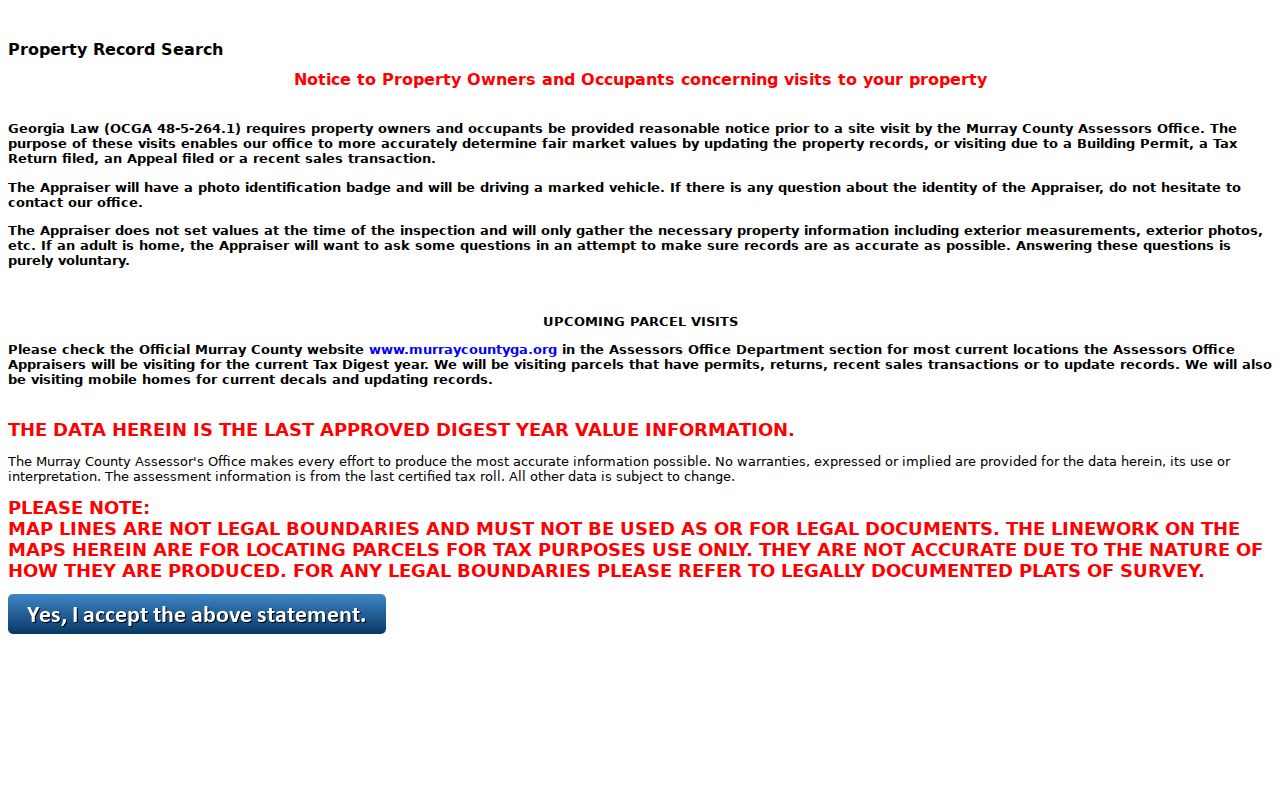
The assessor page states its own limits plainly. Assessment data reflects the approved digest. Map lines are for reference only. They are not a survey. QPublic shows the owner field tied to the tax roll, not a final opinion on title, so treat it as one piece of Murray County property records rather than the whole record.
- Search the situs address in Murray County QPublic and capture the parcel number and owner field.
- Use that name and any deed book/page reference in the GSCCCA real-estate index.
- Open the newest relevant deed and match its legal description to the parcel.
- If the grantee is an entity, check its Georgia Secretary of State record; if it is an estate or trust, preserve the fiduciary role.
Identify Murray Ownership Across Two Dates
The Murray County tax roll is a dated record, not a live feed. Assessment notices and tax bills follow the owner of record on January 1. Buy a parcel after that date and the change may wait. The buyer's name can stay off the roll until the next cycle. No county source promises a fixed number of days from recording to a QPublic update. Patience helps.
The deed index runs on a different clock. It tracks recorded instruments as the clerk files them. For a recent closing, the newest deed matching the parcel is the stronger proof. It shows who owns the Murray County property now. The current Murray County owner guide walks through the present-tense card fields in more detail.
Trace Murray County Property Owner Evidence
Each source answers a narrower question. The assessor names the tax-roll party. The Clerk's deed index leads to the recorded conveyance itself. A business registry explains what an entity name on a deed records entry means. The GIS map helps you orient. It does not prove title on its own.
| Source | Owner Info It Gives | Access |
|---|---|---|
| Murray QPublic card | Owner field, mailing and situs addresses, parcel number | Online or Assessor office |
| GSCCCA / Clerk | Latest grantee, deed date, book/page, legal description | Index, record room, eCertification |
| Georgia eCorp | Entity status, registered agent, offices, filings | State online search |
| Probate Court | Estate, will, and fiduciary context | Counter or written search |
Murray County property records list two different addresses for most parcels, and mixing them up leads people astray. The mailing address is just where the tax bill goes. It might point to a company office, a care-of contact, or an owner living far outside Murray County, so it proves nothing about residency.
Confirm the Latest Murray County Grantee
Run the QPublic owner name through the GSCCCA deed index. That is step one. Then separate true conveyances from security deeds, liens, and releases. Only transfers of title change who holds the land. The newest deed counts only when its land lot, district, acreage, parcel reference, or prior deed citation lines up with the subject parcel.
For 1979 forward, GSCCCA is the documented path into Murray County deed records. The Clerk record room at 121 N. Third Avenue is the fallback. eCertification can deliver a secured certified PDF of the recorded instrument. When the trail reaches 1978 or earlier, the historic Kofile records take over.
Resolve a Murray Owner Result at the Counter
A counter visit still beats a stalled online search. The Assessor office at 121 N. Fourth Avenue can match an address to a parcel card. It keeps a Monday-through-Thursday schedule. The Clerk at 121 N. Third Avenue hands out recorded deeds and plats on weekdays. Because their hours differ, call ahead whenever a lookup needs both offices.
For copies from a distance, the Clerk has published an office email. GSCCCA also offers eCertification for secured certified PDFs. Its fee schedule lists $0.50 per printed image page. It also lists a $5 single-use activation option and a $29.95 monthly Premium account. Confirm the current certified-copy charge with the Clerk before ordering. If a county file sits outside the public index, an Open Records Act request is the fallback.
Decode a Murray LLC, Trust, or Estate
An LLC named on the parcel card is itself the recorded party. Georgia's eCorp Business Search looks up business names, control numbers, registered-agent names, and officer names. Entity detail can show status and filing context. But a registered agent is not automatically the property owner.
A trustee holds title in whatever capacity the instrument states. An executor or administrator may convey estate land under probate authority. Murray Probate Court holds wills and probate records going back to 1834, while the executor or administrator deed should also appear in the Clerk's real-estate record.
Separate Murray Mailing and Situs Fields
The situs field in a Murray County property search tells a different story. It names the parcel itself, the physical land tied to the parcel number. One official assessor entry shows the split clearly: an industrial site's street address sits in the situs field while its mailing address points to a care-of accounting firm, keeping the two claims distinct.
- Owner of record
- The party named on the current tax roll.
- Vesting
- The way a deed states that title is held.
- Grantee
- The party receiving the deed interest.
- Situs address
- The physical location assigned to the parcel.
- Mailing address
- The destination used for notices.
Use Murray FANS After Finding a Name
Georgia's Filing Activity Notification System is free. FANS watches for new filings that match a chosen name, address, document type, or property. Enrollment takes a one-time code sent by email or text. An alert does not block a filing. It is not guaranteed to be complete or current.
If an unexpected alert arrives, inspect the instrument itself. Contact the Murray Clerk. Preserve the alert. Compare the parties and the legal description. Bring in law enforcement or legal help when warranted. FANS tracks new activity; it does not answer who owns this property on its own.
Ask for Existing Murray Owner Records
Georgia's Open Records Act covers existing documents, maps, photographs, and computer data that an agency already holds. A good request names the parcel number, the record type, the date range, and the electronic format you want. Be specific. The agency does not have to build a new ownership report or merge its databases for you.
Three business days is the normal deadline. Exceptional circumstances can extend it. When they do, the agency must state the expected production date, the estimated cost, and the basis for any exemption in writing. Fees for search, retrieval, redaction, and copies may apply, though the first quarter-hour of search time is generally free under the statute.
Match the request to the right custodian. The Assessor keeps the roll card and valuation fields. The Clerk holds deeds, plats, liens, and transfer-tax filings. Probate Court handles estate authority. The Secretary of State explains a Georgia business entity. One narrow request to the correct office beats asking a single desk to assemble every trace of a name across Murray County property records.
If access is denied or delayed, ask for the specific exemption and a production estimate in writing. Request an existing electronic copy where one is available. One privacy request does not scrub every file. Each custodian maintains its own Murray County property records independently.
Know What a Murray Owner Search Cannot Establish
A roll card and a deed identify recorded interests. They do not prove occupancy, resolve unrecorded claims, or replace a title examination. A map line is not a survey. Ask the custodian about a correction or statutory redaction instead of assuming one portal change updates every Murray County record.
The owner field may hold a role. A trustee, executor, administrator, company, or care-of recipient has to be read in context. Remove the role and the record misleads. The role may be the answer to who owns the land.
Before a purchase, watch for trouble. Unresolved easements, liens, probate interests, or competing deeds call for a title professional or an attorney. The plain-language route identifies the official sources and the latest evidence. It cannot guarantee marketable title.
Murray County also splits ownership data from financial and map data. The Tax Commissioner collects the tax bill. That office never sets the owner field or the fair-market value. The GIS outline locates a tax parcel. It proves no boundary. A lien or security deed can burden the land without replacing the deed grantee as owner, so keeping those record types separate is part of answering who owns this property accurately.
Always date each recorded name. Write down the QPublic digest year, the deed recording date, and the date of the property search. A recent conveyance that has not reached the next certified roll explains an apparent conflict. If the legal descriptions differ, stop and resolve the parcel identity before choosing either name.
Lawful use. Murray County owner information supports property diligence, estate work, and civic review; never use it to target, stalk, or harass anyone.
For an evidentiary copy, use eCertification and retain the secured PDF with the dated parcel notes.