
Deed Types Recorded in Murray
Deed records in Murray County reach well beyond simple sales. The Clerk accepts warranty and quitclaim deeds, security deeds, liens, plats, transfer-tax filings, UCC records, releases, and other property instruments. Each lead document signals a different change in ownership or claim on the land.
| Deed Type | What It Does | Common Use |
|---|---|---|
| Warranty deed | Conveys land with stated title promises | Arm's-length sale |
| Limited warranty deed | Limits promises to the grantor's period | Business or estate transfer |
| Quitclaim deed | Transfers whatever interest the grantor has | Gift, family change, or title cleanup |
| Executor or administrator deed | Moves estate property under fiduciary authority | Probate sale or distribution |
| Tax or sheriff's deed | Records a transfer after an enforced sale | Tax sale or judgment process |
A security deed or lien burdens a parcel without conveying it. A warranty or quitclaim deed moves title instead. Read cancellations, releases, assignments, easements, and restrictive covenants beside the deed chain, since a later correction may replace or clarify part of an earlier record.
Pair an executor deed with the Murray Probate file that granted the representative authority. Pair a tax or sheriff's deed with its sale and court record. For every instrument, check whether the grantor conveyed the full tract, a stated portion, an easement, or an undivided interest. The index label alone rarely states that scope.
Murray Deed Indexes Span Two Eras
Murray County deed research runs on a two-era system. The Murray Kofile historic portal indexes land books from 1833 through 1978. It also holds plat books from 1935 through 2008. Deeds from 1979 forward live with GSCCCA instead. The seam between the two is clean, which helps. But no single search box carries a chain all the way through.
Start in the era that holds the transfer you know about. Write down the party spelling exactly, plus the book, volume, and page, before switching portals. Older deeds often skip addresses entirely. A historic instrument may name a land lot, a district, or an acreage figure. It may also list a road, an adjoining owner, or a parent tract. Keep that wording intact, because later subdivisions can sever an address-only trail.
Murray County was carved from Cherokee territory in 1832. It once stretched across land now sitting in neighboring Northwest Georgia counties. So an early deed's county label has to be read alongside its date. Check the land lot, district, and later boundary history too. The first officers were commissioned in 1833. That matches the first year of the historic land index. The Kofile portal is Murray County's remote entry to those older index books.
Note: The handoff to GSCCCA applies to 1979-forward deed work only.
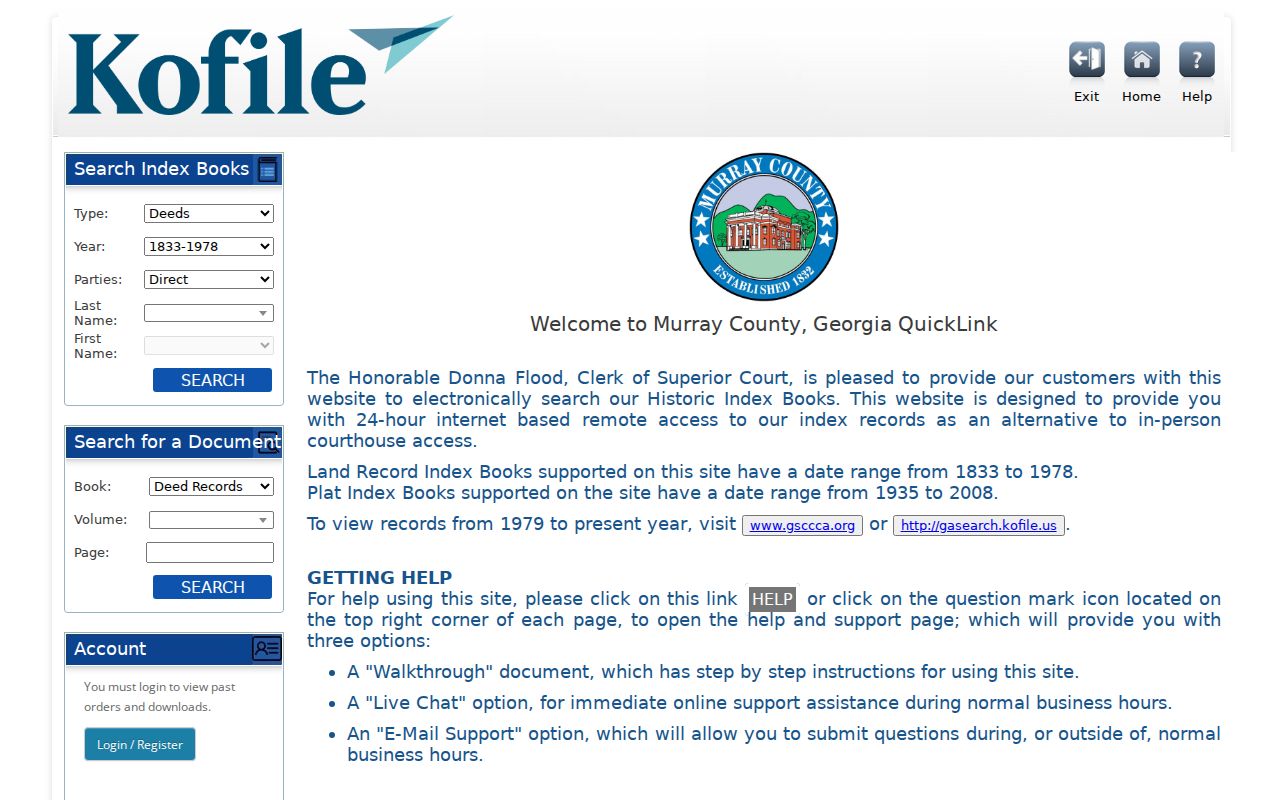
The Kofile portal is a doorway, not a full archive. An index hit does not mean every historic instrument image is online.
Georgia Archives notes that original county records generally stay local. Its county-card system works as a finding aid, not an image library. It can point to microfilm or surviving record groups. Turn a card into a precise request. Then seek the cited volume through the Clerk, a library, the Archives, or a verified FamilySearch catalog entry.
Historic Murray Search Controls
Kifold aside, the Kifold , no, Kofile , Kofile supports two approaches. A party search works from a name plus a rough year. A citation search by book, volume, and page moves faster once another deed, plat, or assessor card hands you the reference.
| Field | Input | Status | Purpose |
|---|---|---|---|
| Type | Dropdown | Not marked | Select an index-book type |
| Year | Dropdown | Not marked | Narrow the historic run |
| Parties | Role selector | Not marked | Choose the indexed side |
| Last / First Name | Name controls | Not marked | Locate party entries |
| Book / Volume / Page | Citation controls | Not marked | Open a known reference |
Old handwriting and odd spellings can stall a search. When a name or a missing image blocks the trail, carry the citation to the Clerk's record room. There, run the same party through both halves of the index. A grantor entry marks an interest going out. A grantee entry can point back to that person's earlier acquisition. Try abbreviated first names, initials, entity variants, and handwritten spellings as separate searches. Record the year and index type beside every hit. Identical book-and-page numbers mean little outside their record series.
Walk Murray Grantors and Grantees
A grantor-grantee index tracks names, not modern street addresses. Begin with the newest deed tied to the parcel you know, then step backward one transfer at a time. Where anything looks uncertain, search name variants in both roles.
- Find the present owner's acquisition deed with that owner as grantee.
- Read the grantor, recording date, legal description, and prior citation.
- Search that grantor as an earlier grantee and compare the tract wording.
- Repeat until the chain reaches Kofile, a deed book, probate file, or archive.
- Grantor
- The party conveying an interest.
- Grantee
- The party receiving that interest.
- Chain of title
- The ordered record of transfers affecting the same land.
- Book and page
- A citation used to retrieve the recorded instrument.
Note: Compare each legal description before stepping back, since a name match may involve a different tract or only an undivided interest.
Current Murray Deeds at GSCCCA
The GSCCCA Real Estate Index covers current Murray County deed records. It is the live name-search route. The statewide service also runs book and page, lien, plat, PT-61, and UCC lookups. Premium tools extend searching to address and instrument type. Result labels on the live system vary by search. So match each finding back to its citation.
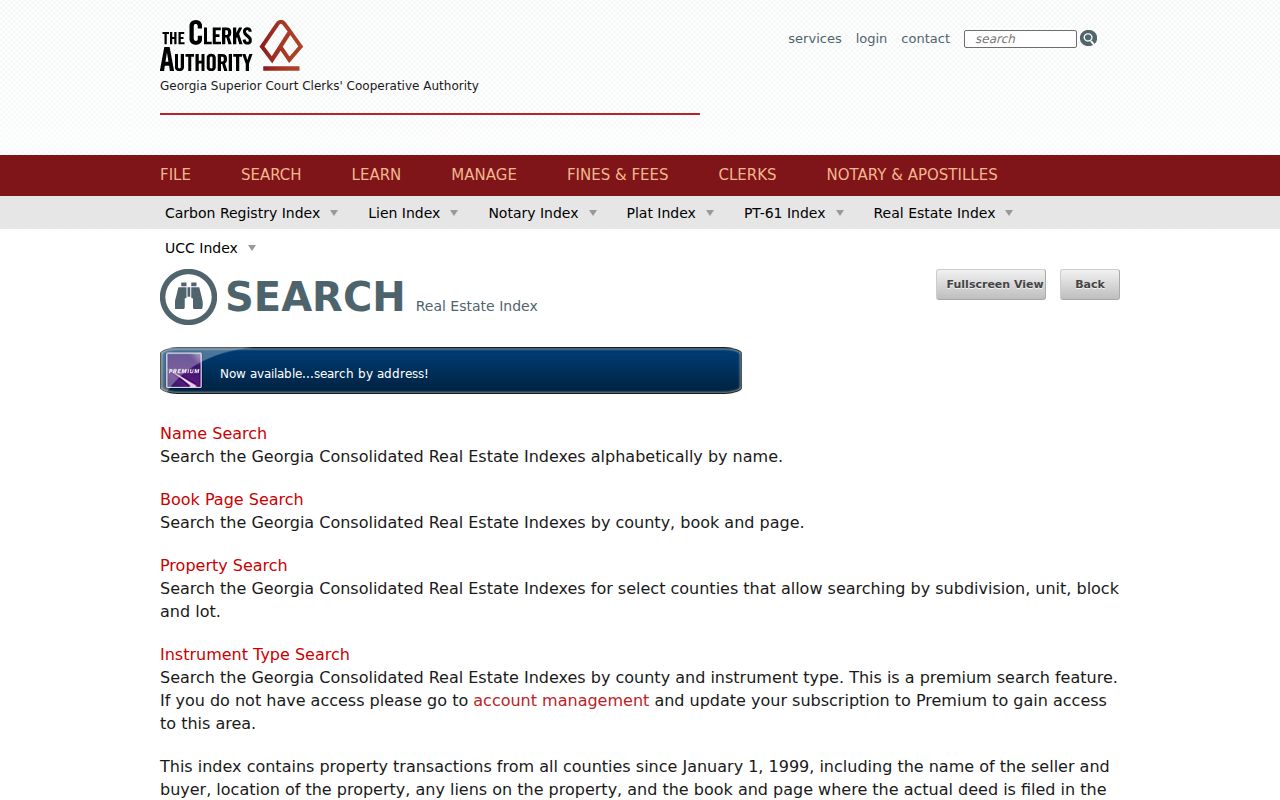
Select Murray County and capture the full book-and-page or instrument reference for the document.
A Zero-Dollar Murray Transfer
One assessor sample shows a Murray County transfer from July 1997 recorded at zero dollars. It lists reason QC and qualification U. A zero figure does not mean the land had no value. It usually signals a quitclaim or another non-market event behind the deed. So the sales row on a parcel card can mislead anyone hunting a sale price. Gifts, estate distributions, entity transfers, title cleanup, and corrections all produce nominal figures. They still move a legal interest.
Always read the deed itself and the transfer-tax record first. Then weigh the consideration against the deed type and the transfer-tax filing. Consider the sale qualification and the sales nearby too. Partial or undivided interests complicate things further. The parcel card's short row may not capture the full scope. So the legal description in the deed is essential.
Murray Liens and Plat Cross-Checks
Liens and plats add depth to a Murray County property records search. Under an owner of record, look for judgments. Also look for tax liens, mechanic's liens, hospital liens, and lis pendens. Plats carry their own clues. A recorded plat shows subdivision lots, easements, roads, and dedications. A deed may only hint at those. Watch for releases too. A release can cite an older security deed without restating the full legal description.
Recorded plats live in the Clerk's record room. The Assessor can supply a plat reference. The County Surveyor may point to related survey records. A QPublic map is not a substitute for that recorded material. For any apparent encumbrance, note the filing date, parties, type, citation, and any linked release. A name-only hit can belong to a different person or parcel. A lis pendens also just points to a court case. The Superior Court file and later judgment decide the dispute. Those may be needed as well.
Free Murray Filing Alerts
Georgia offers a free early-warning tool for deed activity. The Georgia Filing Activity Notification System sends alerts when new filings match a chosen name, address, or document type, including real-estate records. Login is simple. A one-time email or text code gets you in.
FANS has limits. It cannot block a deed from being recorded, and it does not guarantee complete or current alerts. An unexpected notice deserves a closer look. Check the index directly, pull a copy of the filing, and contact the Clerk plus qualified legal help.
Save the alert itself. Compare the filed parties, legal description, recording date, and signatures against the known deed chain. Search as well for connected security deeds, liens, assignments, and releases. If the filing looks fraudulent, the practical route runs through the Clerk, local law enforcement, and an attorney or title professional. The alert service cannot scrub a public index entry.
Order a Murray Deed Copy
Deed copies come straight from the Murray County Clerk of Superior Court. The office sits at 121 N. Third Avenue in Chatsworth and opens Monday through Friday, 8:30 a.m. to 5:00 p.m. Call 706-695-2932 or write to clerksoffice@murraycountyga.gov with questions. Ask about a citation, archive retrieval, current charge, or certification. When an index image is missing, the record room is the direct fallback.
GSCCCA pricing is published plainly. Printed pages run 50 cents each. A Premium account costs $29.95 a month, and a single-use activation is $5. Murray's eCertification route delivers secured PDFs. The requester picks the county and document type, supplies the required details, and approves the final charge.
Recorded, not guaranteed. Murray deed records show what reached the public index. They do not resolve every defect, priority issue, missing release, or unrecorded interest and are not a title opinion.
Murray County deed records dating from 1833 through 1990 got special care. In 2016, that span was inventoried, sorted, indexed, and rehoused in archival boxes. That work explains a useful quirk. An office or archive request can succeed even where the web index runs thin. Georgia Archives county cards and the history wing at the Chatsworth-Murray Public Library add further finding aids, so record each source and search date for the next researcher.